
We often discuss violations of children's rights as soon as they occur and based on their visible outcomes. However, when we evaluate a violation only in terms of its moment, place, a single institution, one child, or a single "incident," we overlook the conditions that make that violation possible.
Children dropping out of education, being subjected to violence, growing up in poverty, being forced to work, or encountering the justice system cannot be seen as merely individual or isolated situations. This picture requires us to consider structural inequalities, the lack of protective and preventive mechanisms, the weakening of public services, breakdowns in the chain of responsibility, and the extent to which children are involved in decisions affecting their own lives—all together.
Rights Violations: The Litmus Test for Structural Problems
In terms of children's rights, the issue is not only about what is done after a violation; it is about what measures were taken beforehand, how the child was protected when the violation occurred, and what structural changes were made to prevent similar violations from happening again. That is why, alongside asking "what happened?", we also need to ask, "why could this violation not be prevented?", "who failed to fulfill their responsibility?", "which mechanism did not work?", and "where was the child’s voice heard in this process?"
This is because the violations of rights experienced by children are the litmus test for structural problems. Poverty, inequality, weakening of public services, gender inequality, migration, wars, and the climate crisis directly affect children's lives. When children's rights and needs are not prioritized in decision-making and resource allocation processes, children often become the most affected but the least consulted individuals.
At this point, it is crucial to consider the key pillars of children's rights together: the prohibition of discrimination, the best interests of the child, the right to life and development, and participation. These principles cannot be addressed separately.
If the child's voice is not heard, it is not possible to talk about their best interests. If there is discrimination, the participation, protection, and development of some children are limited from the outset. If the right to life and development is not guaranteed, other rights cannot be realized in daily life.
That is why we cannot see children merely as vulnerable beings who need protection or as the adults of the future. Children are rights-holders today; they have the right to have a say in their own lives, schools, neighborhoods, cities, and public life.
Child Participation: Not Just Taking Opinions, But Also Listening to Their Voices
This is exactly where child participation becomes important. Participation is not limited to handing children a microphone or just soliciting a few of their opinions. It requires providing children with understandable information on issues that affect them, creating safe spaces for them to express themselves, taking their words seriously, and ensuring they can influence decision-making processes.
We also need to think about children's freedom of organization from the same perspective. At school, in the neighborhood, in digital spaces, in the face of the climate crisis, for the right to education, or on many issues concerning their daily lives, children witness, reflect upon, and voice what is happening. They come together, raise objections, and develop forms of solidarity. The point is not to say "participate" or "organize" to children; it is to recognize, support, and guarantee their voices, participation, and self-organization.
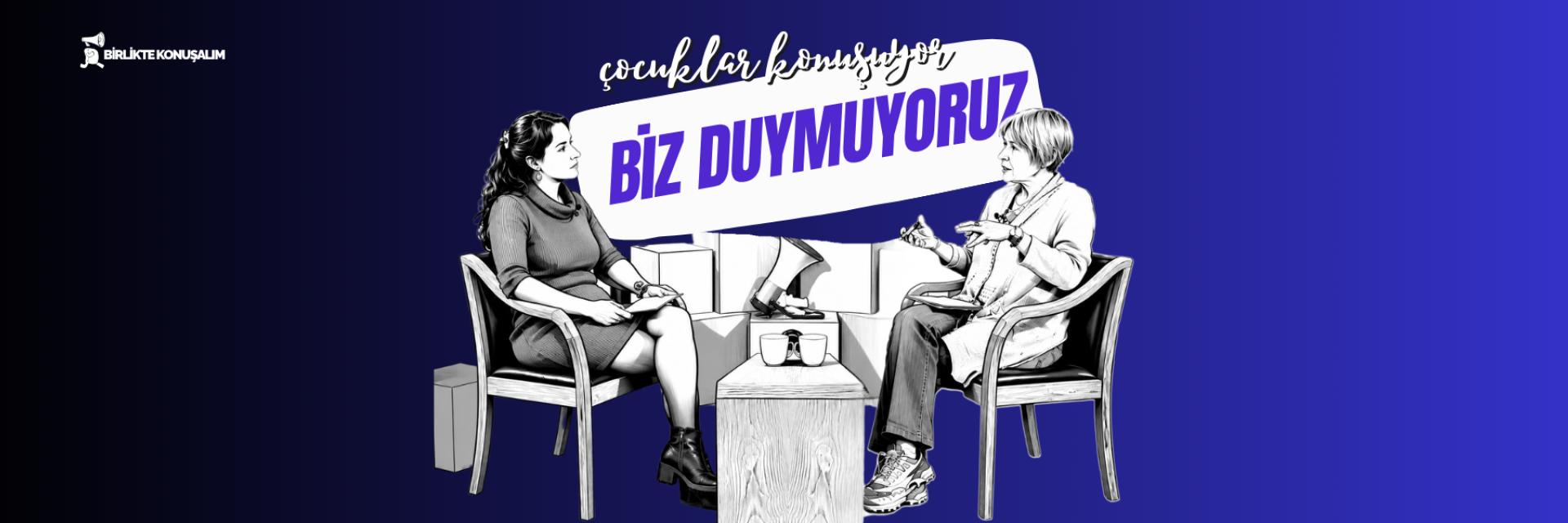
In the latest episode of Let's Talk Together, we discussed how we view violations of children's rights, why these violations cannot be addressed only through their visible outcomes, children's participation, freedom of organization, and what it means to see children as rights-holding individuals. The program also addressed the multidimensional violations children experience, their right to organize, and field experiences. We invite you to watch the program airing on Monday, May 25th, and to think together with us.
You can subscribe to our YouTube channel here.