


Beyond the checklist: Ethics in work done for and with children
In work conducted for and with children, ethics is a structural necessity that must be observed at every stage of the work, going beyond good intentions. Positioning children not just as passive recipients but as agents of the process requires a level of planning too serious to be left to chance.
Ethical principles are fundamental safeguards that protect children’s safety, dignity, and presence as individuals. For this reason, ethics should hold a central place not just in research, but also in workshops, field activities, data collection processes, advocacy work, and internal institutional practices.
In this article, we tried to discuss why an ethical approach is critical in work conducted for and with children, drawing on the ERIC (Ethical Research Involving Children) principles, which offer an important reference framework in the literature.
Why is an ethical framework important?
In work conducted for and with children, elements like access to information, authority to make decisions, process design, and setting boundaries are mostly controlled by adults or organizations. At this stage, the ethical approach steps in to facilitate adults’ standard-setting, to protect the child’s status as an agent, and to make participation free, safe, and meaningful.
It must be remembered that violations are, most of the time, not openly expressed. Invisible states like silence, discomfort, disengagement, or withdrawal are also within the scope of ethical responsibility.
What do the ERIC principles say?
The ERIC framework emphasizes that ethical thinking in work conducted for and with children is not a procedural, but a relational process.
The first step in this process is the principle of respect. This principle safeguards not only the child’s participation but also their presence as an agent. It requires not positioning the child as a passive data source or an object of intervention.
The principle of benefit requires placing the child’s experience and gain at the center of the work. Efforts that do not contribute to the child and focus solely on institutional outputs, reports, or project requirements do not take the child’s best interest into account ethically.
Not every child may have the same conditions, the same resources, or the same means of expression. The principle of justice intervenes at this stage, demanding recognition of different needs and the development of inclusive measures instead of uniform applications.
The principle of non-maleficence forms the basic system of the ethical framework. It requires consideration not only of physical risks, but also of invisible risks such as emotional strain, labeling, exclusion, or triggering trauma. Therefore, conducting a risk analysis for work conducted for and with children should be considered an ethical requirement.
The process of consent is an inseparable part of the ethical framework. It may be one of the principles most emphasized in the field. However, here, crucial details may be overlooked: the perception that consent is a one-time act, the child and/or adult lacking knowledge that the child can withdraw participation, and the fact that silence may also indicate a boundary. An ethical approach regards the child’s will as continuously valid and treats participation as a process that must be reconfirmed at every stage.
By its nature, child data is sensitive data. Privacy does not mean only hiding names; it includes protecting children’s shared experiences, ethical use of created images, and secure storage of all data. In this framework, the principles of confidentiality and privacy require an appropriate data management approach.
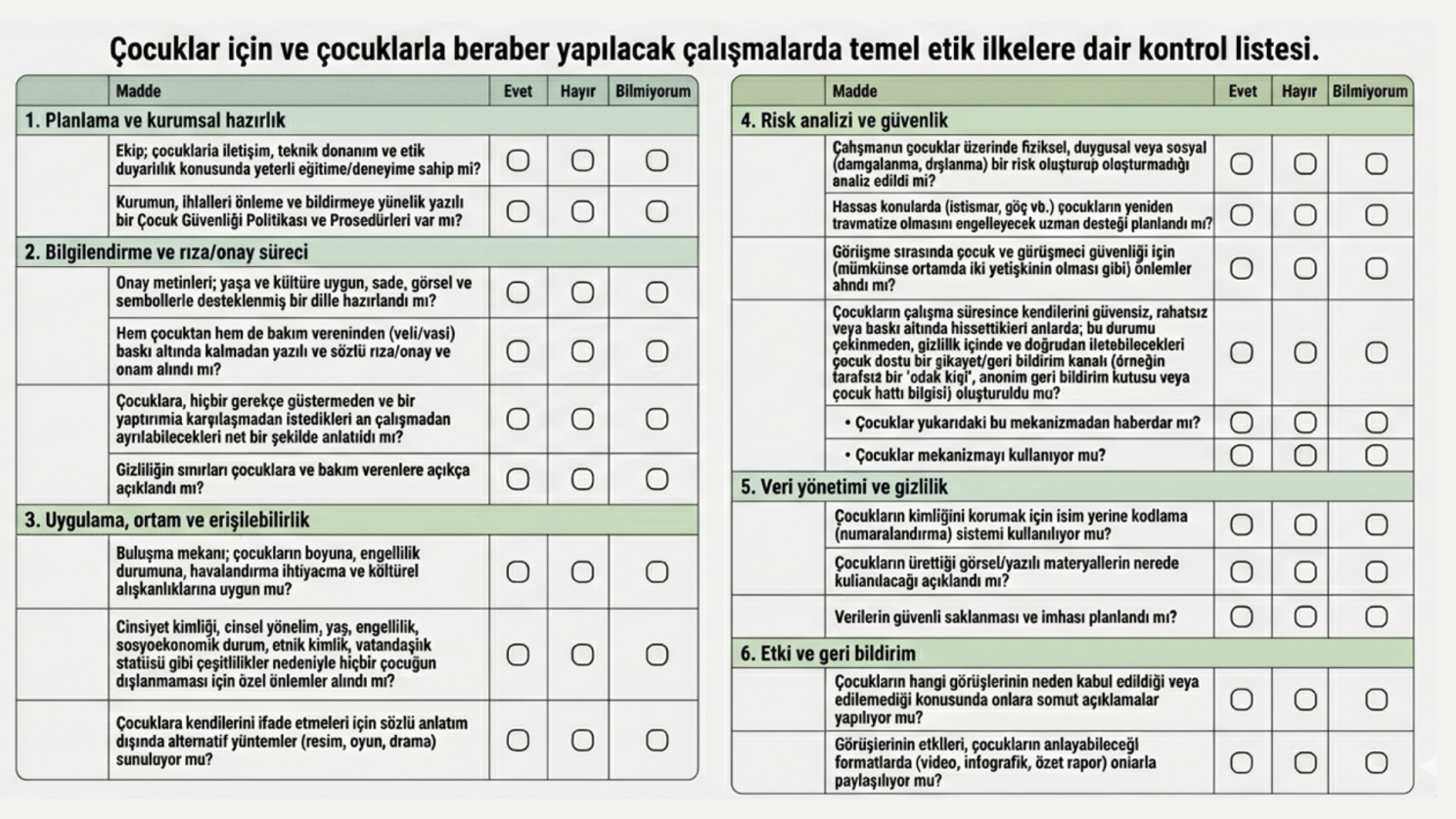
Children First: An institutional check-up for ethical work
You can assess your organization by checking the basic ethical principles in the checklist we share below for work to be conducted for and with children. Your organization may already have regulations regarding the topics or questions listed. However, your lack of awareness or access to that information should also be considered by the organization.
Remember, an ethical approach is not just about ticking boxes; it requires constant organizational reflection.

Subscribe to STGM Youtube Channel!
On the STGM YouTube Channel, you can find various tutorials, presentations and current discussions on civil society. Check out our channel now and subscribe.